Carbon Credits in the Waste Value Chain: Green, Blue & Teal Carbon Explained (with 3 India Case Studies)
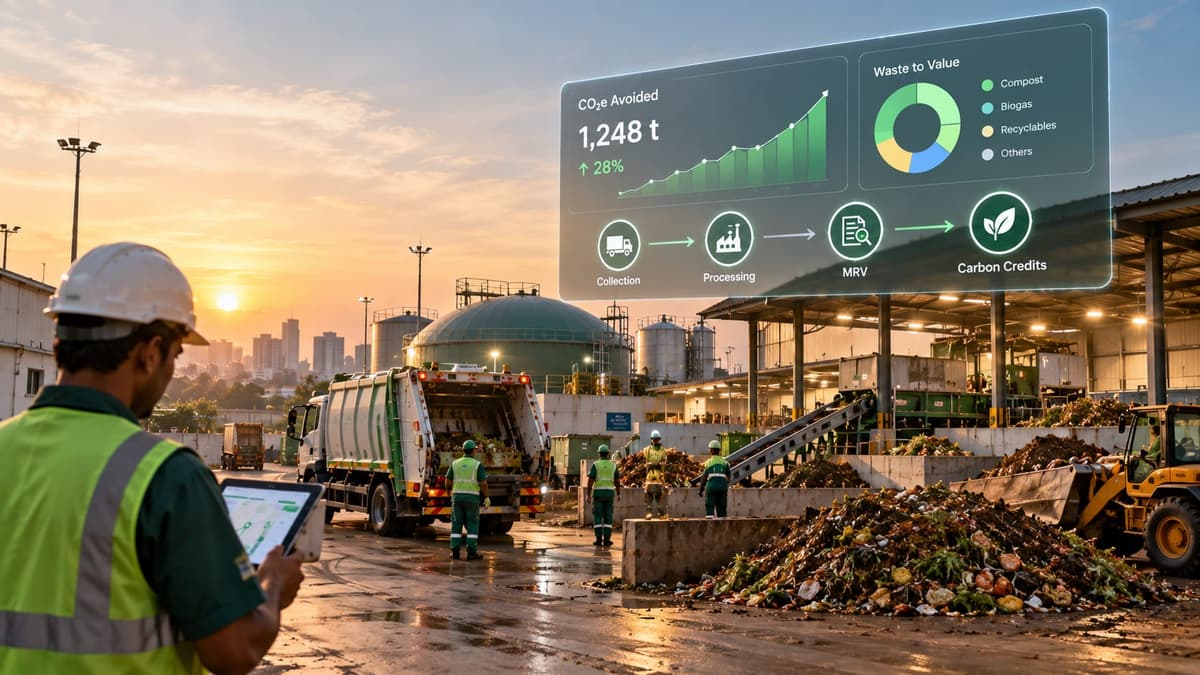
Most people think of waste as the end of the line — something you pay to make disappear. The climate math tells a different story. Organic waste rotting in a landfill releases methane, a greenhouse gas roughly 80 times more potent than CO₂ over a 20-year horizon. Divert and treat that waste properly and you don't just cut emissions — you create a carbon asset that can be verified, credited, and sold.
This is the logic behind carbon credits in the waste value chain. This guide explains the different "colours" of carbon, the credit types that apply to waste, why traceability is non-negotiable, and three India case studies that show circularity working end to end.
From waste to verified credit — the value chain
Waste generation
Logged at source, by type & quantity
GPS-tracked collection
Pickup tagged by location & time
Processing
Composting, biogas & recycling
MRV
Measure · report · verify
Verified carbon credits
Real, additional, sellable
The colours of carbon
Carbon markets have borrowed a colour code to describe *where* carbon is captured and stored:
- Green carbon — carbon captured and stored by land-based ecosystems: forests, grasslands, and agricultural soils. Healthy compost returned to farmland builds green (soil) carbon.
- Blue carbon — carbon captured by coastal and marine ecosystems: mangroves, salt marshes, and seagrass. Blue carbon is among the most dense on Earth — which is why reducing plastic and pollutant leakage into oceans (the focus of projects like SEATRACE) protects it.
- Teal carbon — an emerging term for carbon stored in non-tidal freshwater wetlands and peatlands.
A crucial distinction: green, blue and teal carbon describe sequestration in ecosystems. Most credits in the *waste* value chain are a different category — avoided and reduced emissions (chiefly methane). Waste circularity supports the ecosystem colours indirectly (compost feeds green carbon; less ocean leakage protects blue carbon), while directly generating avoidance credits.
The credit types in the waste value chain
| Credit type | Where it comes from | What it avoids |
|---|---|---|
| Avoided methane | Diverting organic waste from landfill to composting or biogas | Methane (~80x CO₂) |
| Recycling / recovery | Recovering plastics, metals, paper for reuse | Virgin-material production emissions |
| Waste-to-energy | Converting residual waste to energy | Fossil-fuel energy emissions |
| Composting / biochar | Aerobic treatment of organics; biochar to soil | Landfill methane; builds soil carbon |
Credits also split by mechanism: avoidance (stop an emission happening), reduction (lower an existing one), and removal (pull carbon out of the air). Waste projects are mostly avoidance and reduction, verified under standards such as Verra (VCS) and the Gold Standard.
Why traceability is the backbone
Here's the catch: a carbon credit is only worth anything if it is real, additional, and verifiable. That requires MRV — Measurement, Reporting, and Verification — and MRV requires a provable chain of custody. You must be able to show that a specific tonne of organic waste was actually diverted, treated, and never quietly dumped.
This is precisely where waste traceability becomes the foundation of carbon finance. Without it, credits are contestable. With GPS-tracked collection, digital manifests, facility intake records, and AI anomaly detection — the operational layer behind the Reclevo platform and RwAM — every credit rests on evidence rather than estimates.
MRV: the difference between a credit and a claim
Carbon finance lives and dies on three letters: MRV — Measurement, Reporting, and Verification. It is the process that proves a tonne of avoided emissions actually happened, was reported accurately, and was checked by an independent third party.
Why MRV matters:
- Integrity — without rigorous MRV, projects over-credit and buyers lose trust. Almost every credibility scandal in voluntary carbon markets traces back to weak MRV.
- Additionality — MRV is how you prove the reduction would not have happened anyway.
- Price — credits with strong, digital MRV command a premium; unverifiable ones are discounted or simply unsellable.
- Compliance — standards like Verra and the Gold Standard mandate MRV as a condition of issuance.
A real business example. Waste-to-value companies are already monetising this. Blue Planet Environmental Solutions — a waste-management group operating across India and Southeast Asia — has unveiled a carbon-credits portfolio backed by scientific waste processing, turning diverted and processed waste into verified credits. Ventures like this only work because the underlying waste flows are measured and documented well enough to survive independent verification.
That is the gap Reclevo's traceability closes: GPS-tracked collection, digital manifests, facility intake, and AI anomaly detection produce MRV-grade data as a by-product of daily operations — so a credit is defensible the day it is issued, not reconstructed months later.
MRV in action (a short case)
Picture a composting facility claiming 20,000 tCO₂e of avoided methane. With paper logs, a verifier can only sample and estimate — and every gap becomes a discount on the credit price. With a digital chain of custody, the same facility can show, tonne by tonne, GPS- and time-stamped: waste collected, weighed, delivered, and processed. Verification that once took months and shaved value off every credit becomes fast, cheap, and full-value. That discount — the price weak MRV forces onto a credit — is the real ROI of traceability.
Three India case studies (illustrative models)
*The figures below are representative models based on published waste-to-carbon benchmarks (a ~100 TPD facility avoids roughly 30,000–50,000 tCO₂e/year; voluntary-market prices run ~$15–80 per credit). Actual outcomes depend on waste composition, methodology, and verification.*
1. Municipality — organics diversion in coastal Goa
A municipal body collects mixed waste across several wards. By segregating at source and routing ~50 tonnes/day of organic waste to composting and biogas instead of a dumpsite, it avoids roughly 15,000–25,000 tCO₂e per year of methane. At a conservative $20/credit, that's ~$300,000–500,000 in annual carbon revenue — enough to part-fund the collection fleet.
The enabler isn't just the compost plant; it's the verifiable record that each tonne was diverted. Reclevo's on-the-ground pilot in Chicalim, Goa — GPS-tracked collection across multiple collectors and processing facilities — is exactly the kind of traceable operation that makes such credits defensible.
2. Business — a bulk waste generator goes circular
A hotel group (a "bulk waste generator" under the Solid Waste Management Rules, 2026) segregates wet, dry, and recyclable streams across its properties. Diverting ~5 tonnes/day of organics to composting and channelling recyclables to authorised recyclers avoids an estimated 1,500–2,500 tCO₂e/year, while cutting disposal costs and satisfying compliance.
For the business, carbon credits turn a regulatory obligation into a branded sustainability asset — one it can report against with an auditable trail rather than a vendor's word.
3. Facility — an end-to-end circular hub
A materials-recovery facility (MRF) paired with a biogas unit processes ~100 tonnes/day of municipal solid waste. Recovering recyclables, composting organics, and capturing methane for energy avoids roughly 30,000–50,000 tCO₂e/year — a portfolio spanning avoided methane, recycling, and waste-to-energy credits worth hundreds of thousands to millions of dollars annually at market prices.
This is circularity end to end: waste enters as a liability and leaves as recovered materials, clean energy, compost for green carbon, and verified credits.
How to start
- Measure your baseline. Tonnage, composition, and current disposal route.
- Divert the organics first. That's where the biggest methane avoidance — and the most valuable credits — live.
- Instrument the chain. GPS collection, digital manifests, facility intake — MRV-grade data from day one.
- Choose a methodology and standard. Verra or Gold Standard, matched to your project type.
- Verify, issue, and report. Turn the traceable record into issued, sellable credits.
Frequently asked questions
Can waste really generate carbon credits?
Yes — primarily through avoided methane (diverting organics from landfill), recycling, and waste-to-energy, verified under standards like Verra and the Gold Standard.
What's the difference between green, blue and teal carbon?
They describe where carbon is stored: green in land ecosystems (forests, soils), blue in coastal/marine ecosystems (mangroves, seagrass), and teal in freshwater wetlands and peatlands. Waste-value-chain credits are mostly *avoided emissions*, a separate category that supports these ecosystems indirectly.
Why is traceability essential for carbon credits?
Because credits must be real, additional, and verifiable. A provable chain of custody — measurement, reporting, verification — is what separates a genuine credit from an unverifiable claim.
---
Waste is a carbon asset waiting for the right infrastructure. To see how Reclevo makes the waste value chain traceable — and therefore creditable — explore the Reclevo platform, RwAM, or book a demo.
Written by
Reclevo Team
Climate Tech