Compliance & Reporting: Audit-Ready Waste Data under SWM Rules 2016
Every urban local body, panchayat and waste processing facility in India carries a reporting obligation. Under the Solid Waste Management Rules, 2016, operators and local bodies are expected to file periodic returns with their State Pollution Control Board or Pollution Control Committee, which in turn consolidate the picture for the Central Pollution Control Board. On paper, this is how the country knows how much waste is generated, collected, processed and diverted from landfill.
In practice, the report is often the last thing anyone thinks about until the deadline arrives. The data exists in fragments across gate registers, weighbridge slips, contractor logs and someone's WhatsApp messages. Compliance and reporting is the capability we explore here: turning day-to-day operations into audit-ready records, so that a regulatory return is something you generate, not something you reconstruct.
The reality of municipal waste reporting
The reporting framework itself is reasonable. Local bodies are expected to report annually on collection, segregation, processing and disposal. Processing and treatment facilities file their own periodic returns each year to the pollution control board and the concerned local body. The intent is a continuous, verifiable record of what happened to the waste stream over the year.
The friction is not the rule. It is the gap between how operations are recorded day to day and how the return needs to be presented. A ward officer knows roughly how many trips ran and how many tonnes moved, but that knowledge lives in paper registers, spreadsheets maintained by different people, and the memory of the staff who were on shift. When the return is due, someone has to pull all of it together and make the numbers add up.
Why the current system is flawed
Talk to anyone who has actually filed one of these returns and the pattern is the same. The report is assembled in a scramble, close to the deadline, from sources that were never designed to be stitched together.
- The data is scattered. Collection figures sit in one register, weighbridge readings in another, processing output somewhere else. No single record connects a day's operations end to end.
- Numbers get reconstructed, not recorded. When a figure is missing, it is estimated backwards from what seems plausible. The total looks complete, but the trail behind it does not exist.
- It is hard to defend in an audit. When a board or auditor asks "show me how you arrived at this tonnage," there is often no underlying evidence to point to, only a summary that was typed up after the fact.
- ULBs are thin on staff. Many local bodies simply do not have people to spare for reporting. It becomes an overhead that competes with running collection on the ground.
- A weak trail costs more than compliance. Poor data does not just risk a regulatory query. It undermines credibility in cleanliness surveys and rankings, and weakens the case when a body is seeking funds or grants tied to demonstrated performance.
The result is a strange inversion. Cities and panchayats are doing real work on the ground, but the record of that work is the weakest part of the chain. The operations are defensible; the paperwork is not.
What audit-ready-by-default changes
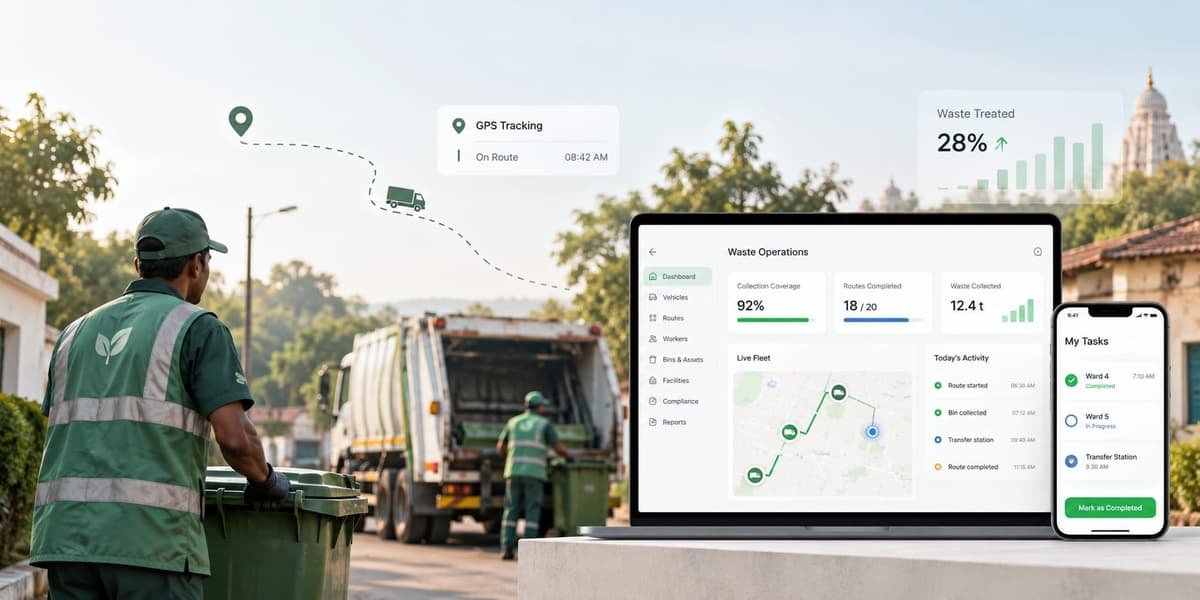
The shift RwAM is built around is simple to state and hard to fake: the record is created at the moment work happens, not reconstructed at the deadline. When collection, weighment and processing are captured as they occur, the reporting problem stops being a data-gathering exercise and becomes a matter of presenting a record that already exists.
We are deliberately not going to walk through every mechanism behind this. What matters is the outcome, and the outcomes are the point:
- A continuous trail instead of a deadline reconstruction. Because operations are logged as they happen, the year's data is already assembled when the return comes due.
- Numbers you can stand behind. Every figure in a return traces back to the underlying operational record, so an auditor's question has an answer rather than an estimate.
- Far less time lost to reporting. Thin-staffed bodies stop losing days to assembling registers, and put that time back into service on the ground.
- A stronger position for funds and rankings. A defensible data trail strengthens the case in cleanliness assessments and in any process where performance has to be demonstrated, not merely asserted.
- One structure, aligned to the return. Data is organised around what SWM Rules 2016 reporting actually asks for, so the periodic return is a generation step, not a rebuild.
The aim is not to make reporting fancier. It is to make it a non-event, a byproduct of running operations well rather than a separate project that consumes the people who should be running collection.
| Manual reporting today | With RwAM |
|---|---|
| Data scattered across registers, slips and spreadsheets | One continuous operational record |
| Numbers reconstructed near the deadline | Figures captured as work happens |
| Hard to defend when an auditor asks | Every number traces to its source |
| Days of staff time consumed each cycle | Return generated in minutes |
| Weak trail undermines survey and funding claims | Defensible data strengthens the case |
If your municipality, panchayat or facility is heading into another reporting cycle the hard way, it does not have to stay that way. See how RwAM makes audit-ready data the default, or book a demo to walk through your own reporting workflow with us. You can also reach the team directly at director@reclevo.in.
Written by
Reclevo Team
Product