Waste Management Software for Panchayats & Municipalities: A Practical Guide
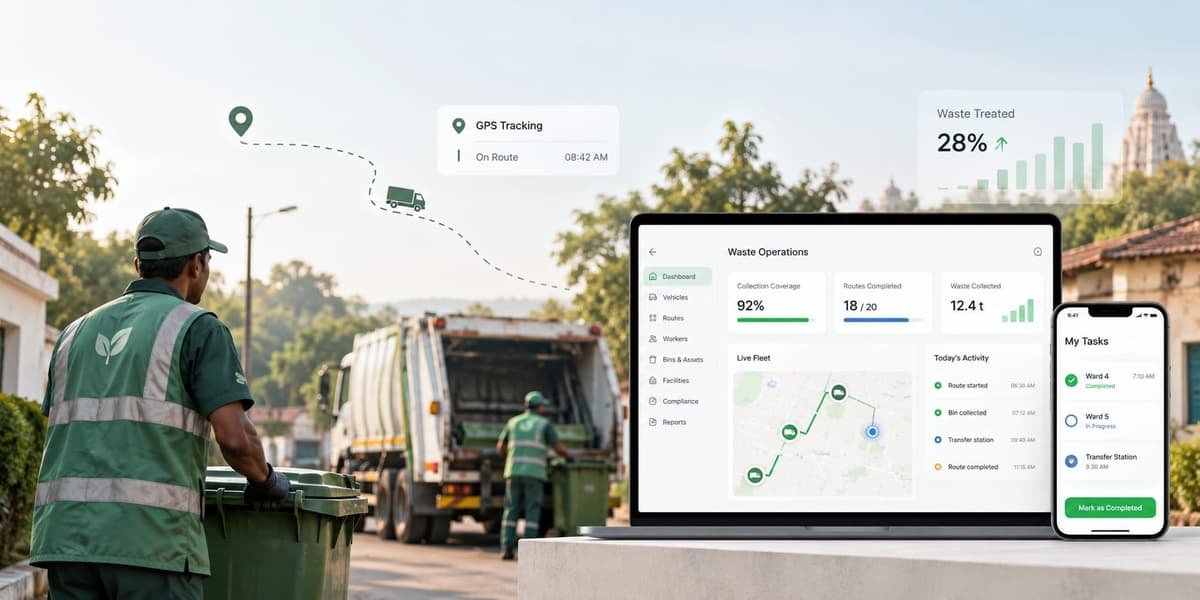
Every single day, India throws away more than 1.6 lakh tonnes of municipal solid waste. Roughly one in five tonnes is never even collected, and fewer than three in ten are actually treated (Ministry of Housing and Urban Affairs). Behind those numbers are the panchayat secretaries and municipal supervisors running collection with fixed routes, paper registers, and a phone that never stops ringing.
Here's the uncomfortable truth: the problem was never a lack of effort. It's a lack of proof. And in 2026, that stopped being an operational nuisance and became a legal one.
The law just changed — and it has teeth
For years, the Solid Waste Management Rules were treated as a suggestion. Not anymore. The Solid Waste Management Rules, 2026 took effect on 1 April 2026, and through orders on 5 May and 25 May 2026, the Supreme Court turned enforcement into a hard, judicially-monitored obligation.
What that means on the ground:
- District Collectors have been handed real power — delegated under Section 5 of the Environment (Protection) Act, 1986 — to enforce SWM implementation, backed by dedicated Special Cells with Pollution Control Board officers.
- The penalties are blunt. Those cells can order the stoppage of water and electricity to bulk waste generators who ignore the Rules.
- Money is now ring-fenced. Every Urban Local Body must earmark a minimum of 30% of its total funds for cleanliness and solid waste management.
A Supreme Court-empowered Monitoring Committee — five Union Secretaries and the Member Secretary of the CPCB — was given sweeping authority, in the Court's words, to:
"supervise, monitor, and issue all primary, ancillary, and incidental directives" required for the implementation of the Solid Waste Management Rules, 2026.
Translation for anyone running collection: "we did our best" is no longer a defence. You will need to *show* what happened — route by route, ward by ward, bin by bin. That is where software stops being a nice-to-have.
What waste management software actually does
Strip away the jargon and it does one thing: it replaces "trust me" with a record. Instead of spreadsheets and radio calls, a supervisor gets a single live dashboard covering vehicles, workers, bins, facilities, and compliance.
In practice, that looks like:
- Route planning + GPS tracking — compare the route a truck *should* have run with the one it *actually* ran
- Attendance & tasks, tied to location — no more proxy attendance
- Asset & bin monitoring — catch a broken compactor or an overflowing bin before a citizen complaint does
- Digital compliance & manifests — audit-ready records for GSPCB, CPCB, and Swachh Bharat
- Dashboards that decide, not just display — turn today's operations into tomorrow's plan
Why panchayats keep getting left behind
Most waste software is built for big city corporations or Western haulers. Rural and semi-urban gram panchayats — which quietly handle door-to-door collection, segregation, and local processing for a huge chunk of the country — rarely fit those tools. They run smaller fleets, patchy connectivity, and lean teams. They don't have six months and an enterprise budget for a rollout.
That's the gap platforms like Rapid Waste Asset Management (RwAM) are built to close: an AI-native "virtual manager" designed for panchayats, municipalities, and processing facilities from day one — not retrofitted for them.
What to look for (and what to ignore)
When you evaluate a platform, weigh these:
| Capability | Why it matters |
|---|---|
| Real-time GPS + route adherence | Proves collection actually happened; cuts fuel and missed pickups |
| Asset & predictive maintenance | Stops vehicle and equipment downtime before it starts |
| GPS-based workforce attendance | Ends proxy attendance; ties work to a real place and time |
| Digital compliance & manifests | Audit-ready proof for GSPCB / CPCB / SWM Rules 2026 |
| Facility capacity & tokens | No queues, no overloaded processing sites |
| AI operations assistant | Ask "which wards missed pickup today?" in plain language |
The one test that matters most: can you prove, after the fact, that waste moved from generation to disposal? That's the line between an activity log and genuine waste traceability — and it's exactly what the 2026 Rules now demand.
How to actually roll it out
- Start with one ward or route. Digitise a single, well-understood beat before you scale.
- Map your assets first. Vehicles, bins, workers, facilities — a clean register is the foundation everything else sits on.
- Train the supervisors, not just the operators. The value shows up in the dashboard, so the people reading it matter most.
- Wire in compliance from day one. When reporting is a by-product of daily work, audits stop being fire drills.
- Pick three numbers and watch them. Collection coverage, fuel per trip, complaint resolution time. Baseline them, then beat them.
Frequently asked questions
Do the 2026 Supreme Court rules apply to small towns and panchayats?
Yes. The Solid Waste Management Rules, 2026 are being enforced pan-India, with District Collectors empowered to drive implementation locally. Smaller bodies are not exempt — which is exactly why affordable, right-sized software matters.
Is waste management software only for big cities?
No. Modern platforms scale down to gram panchayats and small municipalities with lean fleets. The trick is choosing a tool built for Indian operations, not a Western hauler-first product bolted onto local needs.
How does it help with compliance and Swachh Bharat?
Because the records write themselves as work happens — GPS trails, timestamps, digital manifests. Compliance becomes a by-product of doing the job, not a separate month-end scramble.
Do field workers need expensive devices?
Usually a basic smartphone is enough. Attendance, task updates, and site photos are captured in the field and synced straight to the dashboard.
---
Waste operations are won or lost on visibility — and after 2026, on your ability to prove it. If you run collection for a panchayat, municipality, or facility, see what an AI-native operations platform looks like with Rapid Waste Asset Management (RwAM), or book a demo.
Written by
Reclevo Team
Waste Tech